
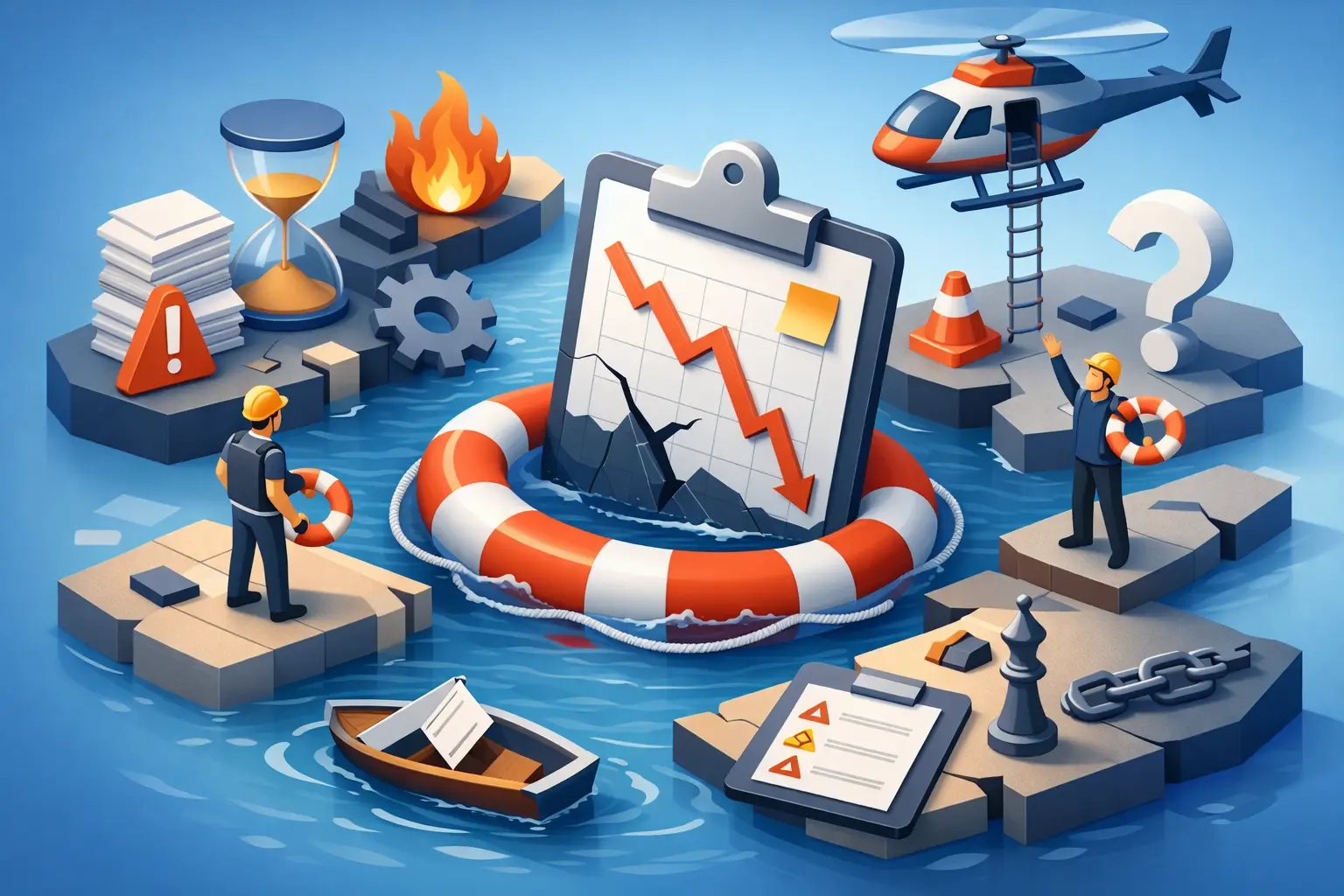
A project does not need rescue only when it has missed its deadline or exhausted its budget. By then, the damage is usually visible to everyone. The harder question is: when do projects need rescue before the organisation absorbs more cost, disruption and reputational risk?
The answer is usually earlier than leaders think. Projects rarely fail in one dramatic moment. They drift. Decisions slow down, risks sit unresolved, scope expands quietly and teams begin working around each other instead of towards the same outcome. A recovery effort works best when it begins while there is still something practical to recover: trust, momentum, funding, capability or a viable path to delivery.
The difference between a difficult project and a project in trouble
Every significant project has pressure points. A regulatory deadline moves, a supplier underperforms, a key stakeholder changes direction or a technical dependency proves more complex than expected. That is normal delivery work.
A project needs rescue when the team can no longer manage those pressures through its existing governance, leadership and controls. The issue is not that a risk exists. It is that nobody owns the response, nobody can make the required decision, or the impact is no longer understood.
The clearest warning sign is a loss of control. Leaders may still receive status reports, but they no longer have a reliable view of what has been delivered, what remains, what it will take to finish and where the real risks sit.
8 signs a project needs rescue
1. The plan is no longer credible
Most troubled projects still have a plan. The problem is that it bears little relation to the work happening on the ground.
Milestones may remain green despite known delays. Dates are repeatedly moved without a proper assessment of downstream impacts. The critical path is unclear, or everyone has a different view of it. If the project team cannot explain, in plain language, how it will reach the next major milestone, the plan is not a management tool. It is a document being maintained for reporting purposes.
Recovery starts by rebuilding a delivery plan that is evidence-based. That means validating scope, dependencies, resource capacity, decision points and remaining work rather than simply adding another version number to an outdated schedule.
2. Status reporting is optimistic but confidence is low
Senior leaders often sense trouble before the formal reporting says so. Meetings become tense. Questions receive vague answers. The same issues appear each month with slightly different wording. Team members say they are making progress, but no one can point to completed outcomes.
This gap between reported status and stakeholder confidence is serious. It usually means the project has stopped being transparent, whether deliberately or through weak controls.
A rescue assessment needs to separate facts from reassurance. What has genuinely been delivered? What has been tested, accepted and put into operation? What is blocked? A clear baseline can be uncomfortable, but it gives sponsors something far more valuable than an optimistic update: a decision they can act on.
3. Decisions are delayed, avoided or constantly reopened
Projects move at the pace of their decisions. When ownership is unclear, even relatively straightforward matters can sit unresolved for weeks. Teams then make assumptions to keep moving, only to have those assumptions challenged later.
The opposite problem is just as damaging. A decision is made, then reopened each time a new stakeholder enters the conversation. This creates churn, weakens accountability and makes planning impossible.
A project in this position needs a tighter decision-making structure. The sponsor, steering group and delivery leads need clear authority, decision deadlines and an agreed process for managing changes. Not every issue belongs in a steering committee. But the issues that do belong there must be resolved, recorded and followed through.
4. Scope keeps growing while delivery keeps shrinking
Scope growth is not always poor discipline. In transformation, technology, construction and compliance work, new information can legitimately change what the organisation needs. The danger comes when scope is added without removing anything, reassessing effort or changing the delivery approach.
The pattern is easy to spot. New requests are described as small. Teams are told to be flexible. Requirements are refined late. Testing windows narrow, while expectations rise. Eventually, the project is trying to deliver more with less time and less certainty.
Rescue work requires a hard conversation about the minimum viable outcome. Which elements are essential to realise the intended benefit, meet an obligation or keep operations safe? Which can be staged, deferred or stopped? Protecting the outcome often means reducing the work.
5. Risks and issues are being recorded, not managed
A risk register is not proof of control. It is only useful when risks have owners, treatments, due dates and a clear escalation path.
Projects need rescue when high-impact risks have been open for too long, mitigation actions are vague, or issue logs have become a holding pen for problems nobody can resolve. This is particularly dangerous in regulated industries, cybersecurity, health, financial services and social infrastructure, where a delayed decision can create exposure beyond the project itself.
The recovery approach is practical: identify the risks that can change the delivery outcome, assign accountable owners and drive a short cycle of action. A project does not need fifty risk discussions. It needs the five decisions that remove the greatest uncertainty.
6. The team is busy, but progress is hard to see
Long hours and full calendars can create the appearance of momentum. They can also hide a project that is stuck.
When teams are overwhelmed by meetings, rework, reporting and stakeholder requests, the work that actually advances delivery is squeezed out. Key people may be carrying too much institutional knowledge, while others wait for direction or access to decisions. In some cases, the project manager has become an administrator rather than the person actively governing delivery.
A rescue plan should clarify roles, reset work priorities and expose capacity constraints. This is not about asking people to work harder. It is about making sure the right work is being done by the right people, in the right order.
7. Stakeholders are working to different definitions of success
A project can appear aligned at kickoff and become misaligned as commercial, operational and technical priorities evolve. The sponsor may want a fast launch. Operations may need a stable handover. Technology may be focused on platform integrity. Frontline teams may be worried about the practical impact on customers or staff.
None of those concerns is unreasonable. Trouble begins when they are not surfaced and resolved. The project becomes a series of competing expectations, with each group judging success differently.
Rescue requires a reset around the intended outcome, measurable benefits and non-negotiables. It also requires honest communication about trade-offs. A faster delivery may require reduced scope. A broader outcome may require more time. Pretending there is no trade-off is how projects lose credibility.
8. The sponsor is spending more time chasing answers than making decisions
Sponsors should set direction, remove barriers and make informed choices. They should not have to reconstruct the project’s status from separate conversations with suppliers, executives and delivery staff.
If a sponsor is regularly chasing updates, mediating disputes or discovering problems late, governance has broken down. The project needs stronger delivery leadership and a single source of truth that shows progress, risks, dependencies, financial position and decisions required.
This is often the point where an independent, experienced project recovery lead adds immediate value. They can establish the facts quickly, bring difficult issues into the open and create enough structure for the organisation to regain control without losing more time to internal noise.
What effective project rescue looks like
Project rescue is not a motivational workshop or a new set of colourful dashboards. It is a disciplined intervention that establishes reality, makes the hard calls and creates a workable route forward.
The first step is a rapid assessment. This examines the current scope, plan, governance, budget position, delivery capability, stakeholder alignment, supplier performance and key risks. The aim is not to produce a lengthy report. It is to answer the questions leaders need answered now: Can this project still achieve its purpose? What must change? What decisions cannot wait?
Next comes stabilisation. The team needs a clear baseline, focused priorities and a governance rhythm that supports action rather than creates more administration. Risks are escalated properly. Dependencies are actively managed. Reporting becomes concise, factual and useful.
Then comes recovery delivery. This may involve resetting milestones, simplifying scope, strengthening the project team, repairing stakeholder relationships or changing how work is sequenced. The right response depends on the project. A delayed digital implementation needs different intervention from a stalled construction program or an at-risk compliance change.
At JJPH, project recovery is treated as embedded delivery work. The objective is not to diagnose a problem and walk away. It is to take ownership of the recovery plan, govern the work and help the organisation deliver through the difficult period.
Act before the project becomes a write-off
There is a natural temptation to give a struggling project one more reporting cycle. Leaders hope a delayed dependency will clear, the supplier will recover or the team will find a way through. Sometimes that happens. Often, it simply reduces the options available later.
The right time to seek rescue is when confidence has started to fall and the project’s existing controls are no longer enough to restore it. Early intervention does not mean the project has failed. It means the organisation is choosing evidence, accountability and decisive action over wishful thinking.
A project can survive bad news. What it cannot survive for long is unclear ownership, hidden risk and a leadership group forced to make decisions without reliable facts.



