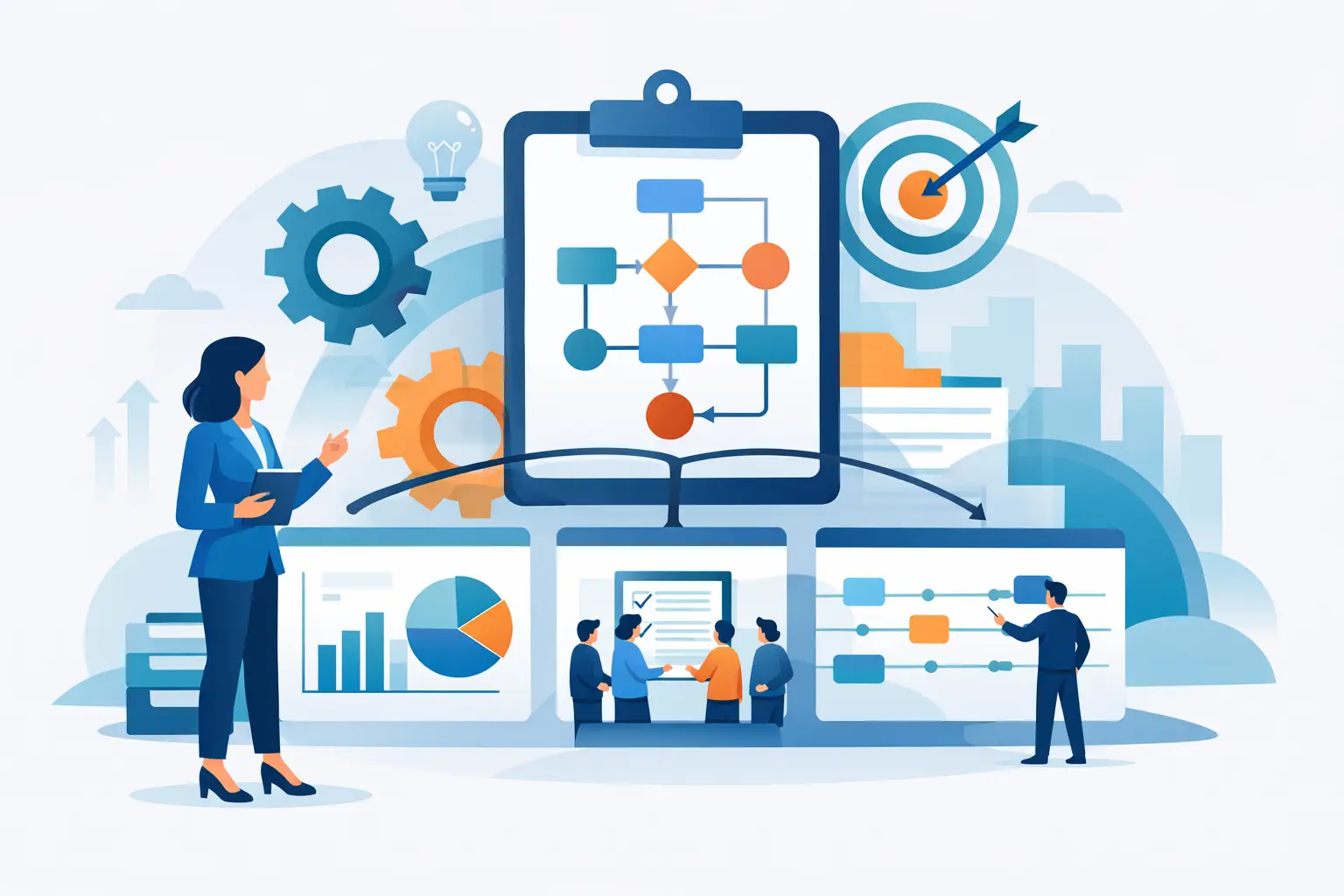
If a transformation is slipping, leaders usually feel the symptom before they name the cause. Too many moving parts. Competing priorities. Projects that look busy but do not add up to a clear result. That is often where the difference between project and program manager stops being a job-title question and starts becoming a delivery risk.
The short version is this: a project manager is accountable for delivering a defined piece of work, while a program manager is accountable for coordinating multiple related projects so they achieve a broader business outcome. Both roles matter. They just solve different problems.
For executives, that distinction matters because the wrong level of delivery leadership creates predictable issues. A capable project manager can still struggle if the real challenge is cross-project dependency, executive alignment, benefit realisation, or governance across a portfolio of change. On the other hand, appointing a program manager to oversee what is really a single contained project can add unnecessary complexity.
What is the difference between project and program manager?
A project manager leads one project from planning through to delivery. They are focused on scope, schedule, budget, risks, resources, stakeholder coordination, and day-to-day execution. Their job is to get a specific initiative delivered properly.
A program manager operates at a higher level across several related projects. They are responsible for making sure those projects work together, support the same strategic objective, and deliver the intended organisational benefit. Their focus is less on individual task management and more on interdependency, sequencing, governance, prioritisation, and strategic alignment.
In plain terms, if you are rolling out a new core platform, the project manager might run the system implementation itself. The program manager might oversee the platform rollout, business process redesign, change management, data migration, risk controls, vendor coordination, and operational transition as one connected body of work.
That is the key difference. One delivers the project. The other makes sure the combined effort delivers the outcome the business actually cares about.
Scope is where the roles diverge first
The clearest distinction is scope.
A project manager works within a defined boundary. There is an agreed objective, a timeline, a set of deliverables, and a team. Even on complex projects, the remit is usually specific enough to plan in detail and manage closely.
A program manager works across boundaries. Their remit often spans business units, vendors, change streams, governance forums, and multiple delivery teams. They are managing uncertainty as much as execution. Some projects may be moving quickly while others are still being shaped. Priorities can shift as the organisation learns more, funding changes, or external requirements evolve.
That broader scope changes the nature of the role. Program management is not just project management at a bigger scale. It requires a different operating lens.
Accountability looks different too
Project managers are measured on delivery. Did the project land on time? Was the scope delivered? Were risks managed? Did the team stay on track? These are practical, execution-level accountabilities.
Program managers are measured on business outcomes. Did the organisation get the value it expected from the combined effort? Were dependencies managed early enough to avoid delays and rework? Were executive decisions made at the right time? Did the change land in a way the business could absorb?
This is where some organisations come unstuck. They assume strong project management will naturally scale into strong program delivery. Sometimes it does. Often it does not.
A program can have several well-run projects and still fail overall because no one is governing the interdependencies, resolving conflicts between workstreams, or keeping the whole effort tied to strategy. Local optimisation is not the same as enterprise delivery.
The difference between project and program manager in practice
On paper, the distinction sounds straightforward. In practice, the line can blur.
Take a regulatory uplift in financial services. One project manager might handle policy updates. Another runs technology changes. Another leads training and communications. Each project could be delivered competently on its own. But if policy decisions affect system design, system delays affect training, and executive reporting needs a consolidated view of risk, someone has to join the dots. That is program management.
The same applies in healthcare, community housing, construction, government, or digital transformation. Whenever multiple streams need to move in concert to produce one business result, the need shifts from individual project control to program leadership.
That does not mean every multi-workstream initiative needs a formal program manager. Sometimes a senior project manager with the right experience can cover both levels if the scale is manageable and governance is clear. But once complexity increases, that dual-role setup often becomes a bottleneck. One person cannot stay deep in execution while also managing enterprise-level coordination indefinitely.
Time horizon and decision-making are not the same
Project managers usually work to a shorter planning horizon. They are concerned with immediate delivery milestones, current resource constraints, and near-term risk actions. Their decisions tend to be operational and tactical.
Program managers work further ahead. They are looking at sequencing, transition planning, funding stages, stakeholder alignment, benefit tracking, and the cumulative effect of change across the organisation. Their decisions are often strategic in nature, even when they affect practical delivery.
That longer horizon matters when organisations are running significant change. A project manager might ask, "Can this team deliver the next phase on time?" A program manager is more likely to ask, "Should this phase proceed now, given the readiness of adjacent workstreams and the business's capacity to absorb change?"
Both questions are necessary. They just sit at different altitudes.
Governance is a major dividing line
One of the biggest differences between a project manager and a program manager is governance.
Project governance is usually centred on the project itself - status reporting, risk logs, budget tracking, scope control, and stakeholder decisions tied to that initiative.
Program governance is broader and more demanding. It requires a structure for escalation across projects, decision-making at executive level, benefits oversight, prioritisation between competing streams, and clarity around ownership when issues fall between teams. Without that structure, programs tend to drift. Everyone is working, but no one is fully in control of the whole.
This is why program managers need strong executive engagement. They are not only managing delivery teams. They are helping sponsors make good decisions early enough to protect outcomes.
Which one does your organisation actually need?
The honest answer is: it depends on the shape of the work.
If you have one defined initiative with a clear scope, known stakeholders, and a contained delivery path, you likely need a project manager. If you are coordinating several related initiatives that must align to deliver a strategic objective, you are in program territory.
There are a few practical signals. If delays in one stream are affecting several others, if reporting has become fragmented, if no one owns cross-functional dependencies, or if executives are getting multiple versions of the truth, you probably do not just have a project problem. You have a program management gap.
Likewise, if your team is spending more time reconciling priorities than moving work forward, that is a sign the initiative needs leadership above the project level.
Why the distinction matters for delivery outcomes
Senior leaders rarely care about role definitions for their own sake. They care because delivery confidence drops when accountability is misaligned.
A project manager placed into a true program environment can end up overloaded, forced to choose between detail and coordination. Risks emerge late. Decision-making slows down. Stakeholders lose visibility. Teams start protecting their own workstreams instead of solving for the overall result.
The opposite is also true. If a contained project is over-managed like a program, governance can become heavier than the work itself. That adds cost in time, not just administration. Delivery loses momentum.
The right role creates clarity. Teams know who owns day-to-day delivery. Executives know who is integrating the bigger picture. Risks are surfaced at the right level. Decisions move faster because the governance model fits the complexity of the work.
For organisations dealing with transformation, compliance, infrastructure, or growth, that fit matters more than title purity. What you need is delivery leadership matched to the actual challenge.
A practical way to think about it
If the question is, "Who will deliver this initiative?" you are usually talking about a project manager.
If the question is, "Who will make sure all these initiatives come together, in the right order, under the right governance, to produce a business outcome?" you are talking about a program manager.
That sounds simple because it is. The challenge is that many organisations only recognise the gap after delivery starts to wobble.
The better move is to assess the complexity early. Look at the number of workstreams, the level of executive coordination required, the degree of dependency across teams, and how much change the business needs to absorb at once. That will tell you more than any title ever will.
At JJPH, we see this regularly across transformation and operational uplift work. When the role matches the real delivery task, governance improves, visibility improves, and projects stop competing with each other for oxygen.
If your organisation is asking whether it needs a project manager or a program manager, the useful question is not which title sounds more senior. It is which level of ownership your delivery environment genuinely requires - because getting that call right early is far easier than recovering a project once complexity has already outrun control.