
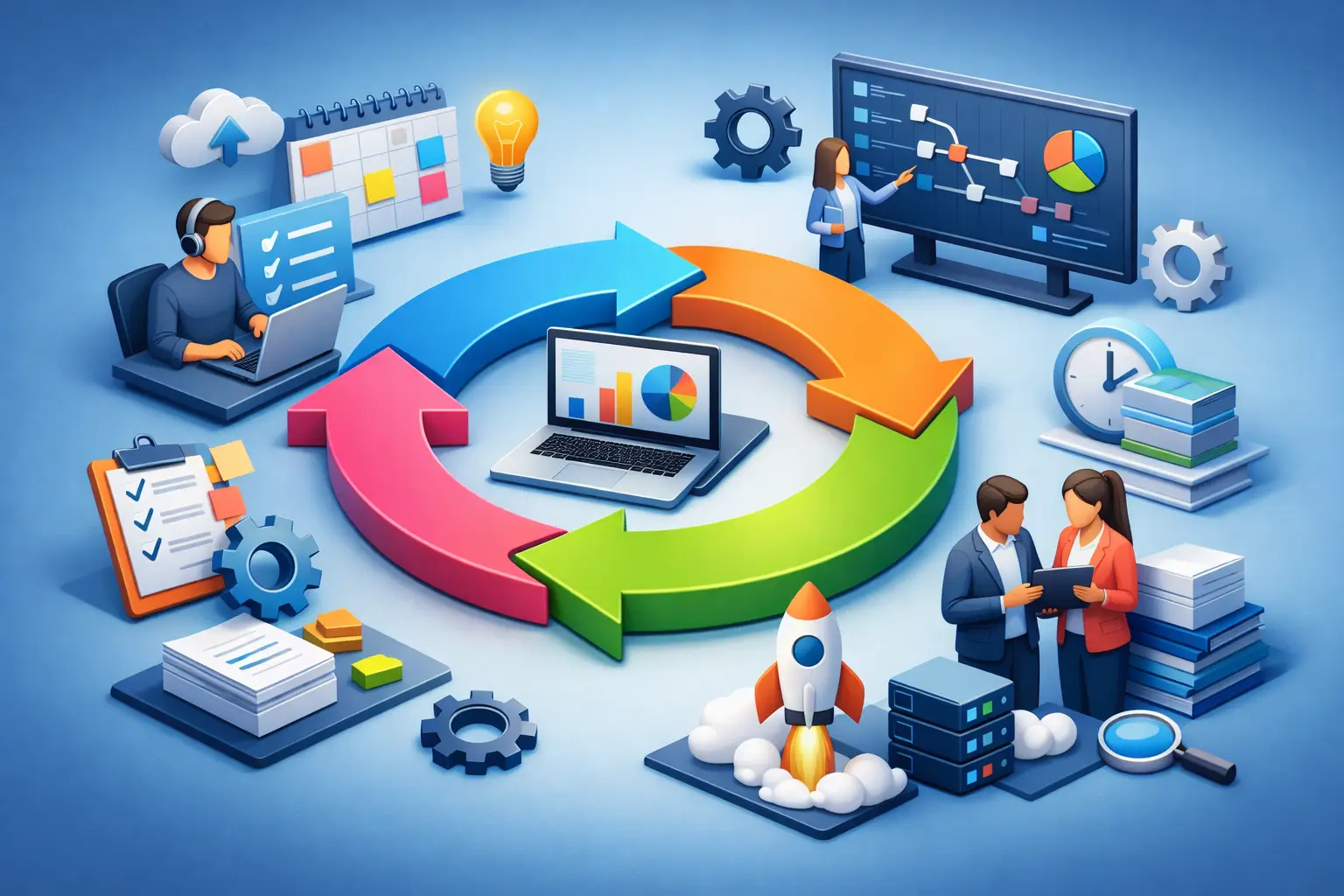
Software projects rarely fail because someone forgot how to code. They fail because scope shifts, decisions drag, stakeholders pull in different directions, and no one is steering the work from idea to adoption. That is exactly why the question what is software project management life cycle matters to senior leaders - it is the structure that turns a software idea into a controlled delivery outcome.
At its simplest, the software project management life cycle is the sequence of phases used to plan, govern, deliver and close a software project. It gives the work shape. More importantly, it gives leaders visibility over budget, risk, timelines, dependencies and business value.
If you are sponsoring a platform rollout, system replacement, customer app build or compliance uplift, this life cycle is not just a delivery model. It is your control framework.
What is software project management life cycle in practice?
In practice, the software project management life cycle is the management path a project follows from concept to closure. It usually includes initiation, planning, execution, monitoring and control, and closure. In software environments, those phases often sit over technical delivery methods such as Agile, Waterfall or hybrid.
That distinction matters. The life cycle is not the same thing as the software development methodology. A delivery team might use Scrum sprints to build features, while the wider project still needs governance, steering decisions, risk management, budget control, procurement, change management and reporting. Leaders often confuse the two, and that is where trouble starts.
A software team can be highly productive and still have a project that is poorly managed. Features may be shipping, but the business case may be drifting, stakeholders may be misaligned, and operational readiness may be missing. A proper project management life cycle keeps technical effort connected to business outcomes.
The five phases of the software project management life cycle
1. Initiation
This is where the project is defined before real money and momentum are committed. The goal is not to create paperwork for its own sake. The goal is to answer a few hard questions early.
What problem are we solving? What outcome matters to the business? Who owns the decision-making? What constraints already exist around budget, timing, regulation, integration or internal capability?
In software projects, initiation is also where early delivery risk should be surfaced. If the organisation has unclear requirements, fragmented systems, weak executive sponsorship or unrealistic deadlines, those issues need naming now, not halfway through a build.
A strong initiation phase usually produces a clear project brief, initial scope boundaries, key stakeholders, success measures and an agreed governance structure. Without that foundation, planning becomes guesswork.
2. Planning
Planning is where many projects either gain control or start accumulating hidden risk. In software projects, planning should go well beyond a high-level timeline.
This phase translates intent into a delivery approach. That includes scope definition, prioritisation, schedule design, resource planning, dependency mapping, risk assessment, budget tracking, vendor coordination, reporting cadence and escalation paths. If data migration, cyber, procurement, legal review or operational change are involved, they need to be built into the plan from the start.
This is also the point where the project manager sets the rhythm of the project. Who approves what? How will changes be managed? When will the steering group meet? What constitutes a red flag? Good planning does not remove uncertainty, but it makes uncertainty visible and manageable.
For software projects, planning should also account for business adoption. A system delivered on time still fails if users are unprepared, processes are unfinished, or support teams are not ready on go-live day.
3. Execution
Execution is the phase most people notice because this is where the work gets built, configured, tested and coordinated. In software delivery, execution can include design workshops, backlog refinement, development sprints, vendor management, integrations, data work, testing cycles and release preparation.
But execution is not just doing tasks. It is active management. Requirements change, assumptions prove wrong, delivery velocity shifts, and stakeholders ask for more than the timeline can absorb. The project manager’s job here is to keep the project moving without letting it drift.
That means controlling scope, clearing blockers, escalating decisions quickly and keeping everyone aligned on what matters most. It also means making trade-offs in plain sight. If a deadline is fixed, scope may need to move. If the scope is fixed, time or resources may need to change. Pretending every constraint can be held at once is how software projects end up late, over budget and politically exposed.
4. Monitoring and control
This phase runs alongside execution, but it deserves separate attention because it is where leadership gets confidence - or warning.
Monitoring and control is the discipline of checking whether the project is still delivering against plan, and intervening when it is not. This covers status reporting, risk reviews, issue management, budget oversight, schedule variance, dependency tracking, quality control and governance updates.
In software projects, this phase is especially important because progress can look healthy when it is not. A development team may report high activity, yet critical integrations may be slipping. User testing may reveal process gaps that were never addressed. A vendor may be meeting build milestones while documentation, training and support readiness lag behind.
Strong monitoring focuses on leading indicators, not just activity. Are key decisions being made on time? Are stakeholders attending governance forums? Are defects trending up? Is change volume increasing? Are business teams ready for deployment? These are the signals that tell you whether the project is under control.
5. Closure
Closure is where the project is formally completed, handed over and evaluated. On paper, this sounds straightforward. In reality, many software projects rush this phase because teams are tired and the organisation wants to move on.
That is a mistake. Closure should confirm that deliverables are complete, acceptance criteria are met, support arrangements are in place, documentation is finished, outstanding risks are handed over, and lessons are captured. Financial closure matters too, especially where vendors, change requests or implementation phases have shifted over time.
A disciplined closure phase protects the business after launch. It also improves the next project. Organisations that skip proper closure tend to repeat the same mistakes under a different project name.
Why the software project management life cycle matters to executives
For delivery teams, the life cycle provides structure. For executives, it provides control.
A well-run software project management life cycle creates clear decision points. It shows when to approve funding, when to challenge scope, when to escalate risk, and when to delay go-live rather than absorb preventable damage. It also helps leaders distinguish between normal delivery pressure and genuine project distress.
This matters in sectors where systems, compliance, customer experience and operational continuity are tightly linked. In financial services, healthcare, government, community services and regulated industries, software delivery failures do not stay inside the IT function. They hit customers, staff, audit outcomes and executive credibility.
The life cycle is also what makes accountability real. When ownership is vague, software projects drift into committee-led delivery. Everyone is involved, but no one is clearly responsible. A proper life cycle fixes that by establishing governance, decision rights and reporting discipline from day one.
The life cycle is not always linear
This is where nuance matters. The phases are consistent, but the way they are applied depends on the project.
A straightforward system upgrade may move through the phases in a fairly linear way. A digital transformation program with multiple vendors, integrations and staged releases will loop through planning, execution and control repeatedly. Agile projects still need initiation, planning and closure. Waterfall projects still need active issue management and change control. Most real-world software projects are hybrid, whether people admit it or not.
That is why rigid textbook definitions are less useful than practical delivery judgement. The right question is not whether your project is Agile or Waterfall. It is whether the management life cycle is giving the business enough structure, visibility and control to make good decisions.
Common mistakes inside the software project management life cycle
The most common mistake is treating the life cycle as administration rather than leadership. Templates get filled in, status reports get sent, and meetings happen - but weak decisions, unclear ownership and unmanaged dependencies remain.
Another frequent problem is underweighting initiation and planning. Leaders want speed, so teams start building before scope, governance or business readiness are settled. That feels faster at the start and much slower later.
There is also a tendency to focus too heavily on delivery output and not enough on adoption. Software can be technically complete and still fail commercially if users reject it, processes remain broken, or support teams are not prepared.
Finally, many organisations do not scale project management maturity to project complexity. A minor application enhancement does not need the same controls as an enterprise-wide platform replacement. But complex projects absolutely need experienced oversight. This is often where embedded delivery support makes the difference - not by adding bureaucracy, but by bringing discipline to decisions that cannot be left to chance.
The software project management life cycle is not theory. It is the operating model that keeps software delivery aligned to business reality. When it is handled well, leaders get visibility, teams get direction, and projects have a far better chance of landing where they were meant to. If a software initiative matters to your organisation, the life cycle deserves more than a passing mention in the project plan.



