
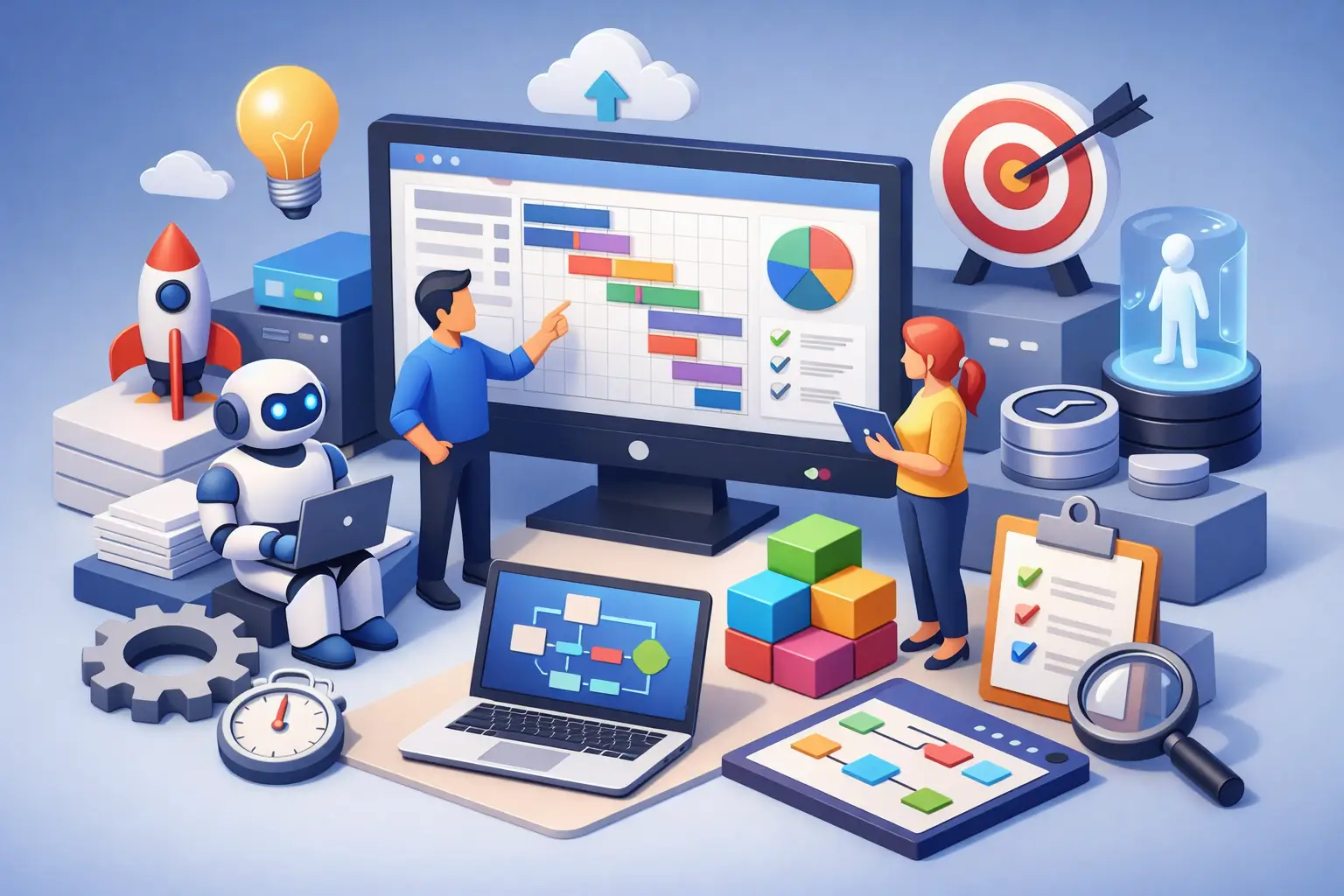
Software projects rarely fail because the idea was bad. They fail because decisions were unclear, priorities shifted, risks were ignored, and nobody had proper control of delivery.
That is why the question what is software project management matters more than it sounds. It is not admin. It is not just updating a timeline or chasing people for status reports. Software project management is the discipline of planning, governing and driving a software initiative from concept through to delivery, while managing scope, budget, timeframes, quality, stakeholders and risk.
In practice, it sits between strategy and execution. Leadership might know the outcome they want - a new platform, a system migration, a customer app, tighter compliance controls, better reporting - but getting there takes more than technical skill. It takes someone who can turn intent into a delivery plan, keep people aligned, and make sure the work lands properly in the business.
What is software project management in practice?
At its simplest, software project management is the coordination of people, work, decisions and constraints so a software project delivers the intended business outcome.
That business outcome matters. A project is not successful because code was written. It is successful because the software solved the right problem, was adopted by users, met operational needs, and did not create more issues than it fixed.
This is where many organisations get caught. They assume software delivery belongs entirely to developers, product teams or vendors. Those groups are critical, but they are not there to carry the full burden of governance, stakeholder alignment, dependency management, executive reporting, procurement decisions, rollout planning and risk control. Without clear project management, gaps appear quickly.
A software project manager creates structure around the work. That includes defining scope, sequencing delivery, clarifying ownership, facilitating decisions, managing interdependencies, tracking progress, escalating issues early and keeping stakeholders focused on what matters. In complex environments, they also bridge the gap between technical teams and business leaders who need visibility without the technical detail.
Why software projects need dedicated management
Software work has a habit of looking simple from the outside. Build the feature. replace the platform. integrate the systems. launch the product. But under the surface, software projects involve changing requirements, hidden technical debt, security considerations, vendor dependencies, testing cycles, user adoption challenges and competing stakeholder views.
That complexity is exactly why software project management exists.
A good software project manager does not just ask, "Are we on track?" They ask harder questions earlier. Do we actually agree on scope? Has the business committed the right subject matter experts? What happens if the integration fails? Are our timelines based on evidence or optimism? Who signs off the design? Are we preparing operations, compliance and customer teams for the change?
Those questions protect the project long before a status report turns red.
For senior leaders, the value is straightforward. Better project management improves visibility, decision-making and control. It reduces the chance that a software initiative drifts for months before the real problems become visible. And when issues do appear, they are surfaced early enough to manage rather than explain away.
The core parts of software project management
The mechanics of software project management vary by project size and delivery model, but the fundamentals stay consistent.
First, there is initiation and planning. This is where the project’s purpose, scope, outcomes, constraints and governance are defined. If this stage is weak, the rest of the project usually pays for it. A vague business case, unclear ownership or unrealistic timeline creates problems that no delivery method can magically fix.
Next comes execution management. This is the day-to-day orchestration of teams, vendors, technical workstreams and business stakeholders. The project manager is not writing code, but they are responsible for making sure the work is progressing in the right sequence, blockers are resolved, decisions are made on time and reporting reflects reality.
Then there is risk and issue management. Software projects always carry uncertainty. Requirements may evolve. Integration points may be more complex than expected. Key people may not be available when needed. Good project management does not remove uncertainty - it makes it visible and manageable.
Stakeholder management is another major piece. Most software projects affect more people than the original sponsor expects. Operations, finance, compliance, customer service, procurement, leadership, external suppliers and end users all have a role to play. Keeping those groups aligned is often the difference between a controlled rollout and a chaotic one.
Finally, there is implementation and transition. Software is not truly delivered when development stops. It is delivered when it is tested, accepted, launched, adopted and supported properly. That means training, communications, support models, cutover planning and post-implementation oversight all matter.
Software project management is not the same as software development
This distinction matters because many organisations blur the line.
Software development is the technical creation of the product or system. It includes architecture, coding, testing, integration and deployment. Software project management is the discipline that governs how that work gets planned, coordinated and delivered within a business context.
The two should work closely, but they are not interchangeable. A strong developer may not want to run stakeholder meetings, manage executive reporting or negotiate scope trade-offs across business units. Likewise, a strong project manager should understand the delivery environment without pretending to be the technical lead.
The same applies to product roles. Product managers focus on customer needs, priorities and feature value. Project managers focus on delivery control, governance, timing, risk and coordination. In some smaller businesses one person may wear multiple hats, but in more complex programs that overlap can create confusion fast.
Agile, waterfall and the reality in between
When people ask what is software project management, they often assume the answer depends on methodology. In reality, the method matters less than disciplined delivery.
Some software projects suit agile ways of working, especially where requirements will evolve and iterative delivery makes sense. Others need more structured planning upfront because of regulation, vendor contracts, fixed dependencies or operational risk. Many sit somewhere in between.
The problem is not agile or waterfall. The problem is using either as an excuse for weak management.
Agile does not mean no planning, no documentation or no accountability. Waterfall does not automatically mean control, clarity or quality. Good software project management applies the right level of structure to the work in front of you. That means understanding where flexibility is useful and where precision is non-negotiable.
For example, a digital product enhancement may benefit from iterative delivery and frequent user feedback. A core system migration in banking, healthcare or community services may need tighter governance, formal sign-offs and carefully managed cutover windows. Treating both the same would be poor judgement.
What good software project management looks like
You can usually tell when a software project is well managed. People know what is being delivered and why. Reporting is clear. Risks are visible. Decisions happen at the right level. Teams are not wasting energy on avoidable confusion.
Importantly, good management does not create bureaucracy for its own sake. It creates enough structure to reduce noise and improve execution.
That might mean a clear governance cadence, realistic stage planning, proper RAID management, disciplined change control and concise reporting that tells leadership what they actually need to know. It also means having the confidence to challenge poor assumptions before they become expensive mistakes.
Strong software project managers are commercially aware as well as delivery-focused. They understand that delays affect revenue, compliance, customer experience and internal trust. They know a technically elegant solution can still fail if it is too slow, too complex to adopt or misaligned with business priorities.
Common reasons software projects go off track
Most software project issues are visible earlier than people think.
Sometimes the project starts with unclear scope and nobody wants to force alignment. Sometimes timelines are set by hope rather than delivery evidence. Sometimes stakeholders agree in principle but not in practice, which surfaces later as rework, delay or political friction.
In other cases, technical teams are left carrying governance work they should never have owned, or executives are too far removed from delivery to make timely calls. Vendor management is another pressure point. If external parties are involved, weak oversight can create delays that ripple across the whole program.
None of this is unusual. The issue is whether someone is actively managing it.
That is why experienced delivery leadership matters. Organisations do not need more noise around software projects. They need clarity, discipline and someone willing to take ownership of the moving parts.
When software project management becomes business-critical
Not every software change needs heavy governance. A minor feature release or contained internal enhancement may only need light-touch coordination.
But once a project affects multiple teams, customer experience, compliance, operations, data, vendors or executive outcomes, software project management moves from helpful to business-critical. The cost of getting it wrong rises quickly. Delays compound. Stakeholder trust drops. Teams lose momentum. Recovery becomes far more expensive than disciplined delivery in the first place.
This is especially true in sectors where change cannot be treated casually - financial services, healthcare, government, social infrastructure, cybersecurity, community services and regulated environments more broadly. In those settings, software projects are not just technology exercises. They are operational change programs with real consequences.
The strongest organisations recognise that early. They do not wait for a project to stall before putting experienced delivery capability around it.
If you are asking what is software project management, the straight answer is this: it is the function that gives software delivery direction, control and accountability. And when the project matters, that is not a nice-to-have. It is what keeps strategy connected to results.



