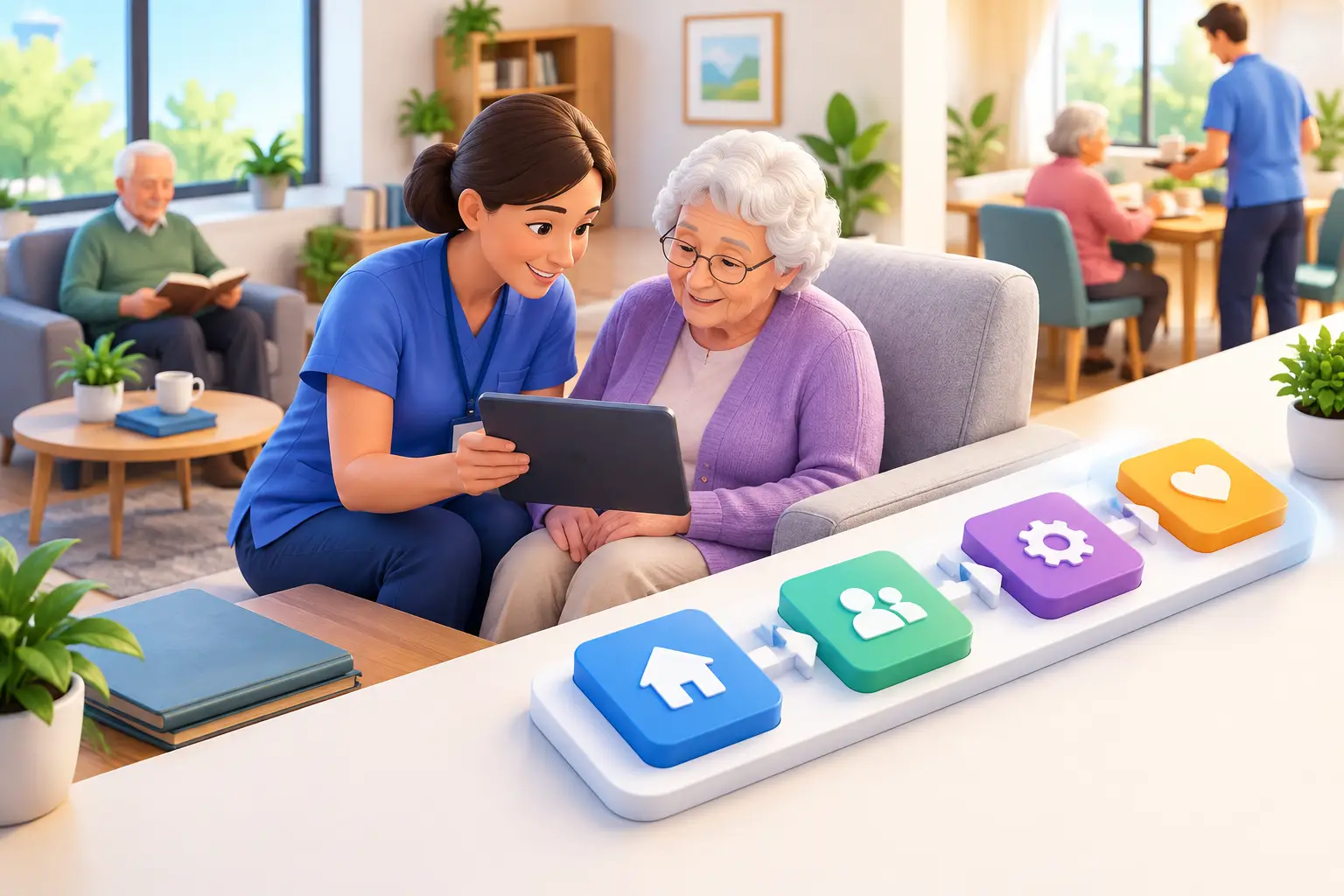
A new care management platform can look like a straightforward technology project until the first shift handover exposes what is really at stake. In aged care, poor implementation creates more than inconvenience. It can interrupt care records, frustrate already stretched teams, weaken compliance evidence and, most importantly, affect residents and families. This aged care implementation example shows what disciplined delivery looks like when the work must protect care continuity while changing the way an organisation operates.
The example is representative rather than a client case study. It follows a mid-sized Australian provider operating several residential aged care homes, with a mix of permanent and agency workforce, decentralised processes and an ageing system that no longer supported consistent reporting.
The aged care implementation example: replacing a fragmented care platform
The provider’s existing care platform had become a daily operational constraint. Staff were recording information across different systems and manual workarounds. Managers could not easily see whether assessments, incidents, care-plan reviews and workforce actions were completed on time. Corporate teams were spending too much time reconciling data before board and executive reporting.
The proposed replacement system offered better mobility, reporting and workflow controls. But selecting software was not the hard part. The real challenge was implementing it without asking care staff to absorb a major operational change in the middle of normal resident care.
The executive sponsor set three non-negotiables. Resident care could not be compromised during transition. Compliance-related records had to remain complete and accessible. And each home needed practical support, not a head-office plan handed down without regard for shift patterns, workforce capability or local routines.
That clarity mattered. It gave the project team a basis for decisions when scope pressures emerged, as they always do.
Start with operational truth, not the vendor timeline
The supplier proposed a standard implementation sequence. It was a useful starting point, but it did not reflect the provider’s real operating environment. A capable project manager began with discovery across homes, speaking with clinical leaders, registered nurses, personal care workers, quality teams, rostering staff, finance and executive sponsors.
This uncovered issues that would not have appeared in a standard configuration workshop. One home used different terminology for care activities. Another relied heavily on paper-based bedside notes during busy shifts. Several managers had created local spreadsheets to track tasks they could not reliably see in the existing system. The organisation also had different levels of digital confidence across its workforce.
None of these findings were reasons to delay the project indefinitely. They were facts to design around.
The team then separated requirements into three groups: legal and care-critical requirements, operational requirements that needed a consistent enterprise approach, and local preferences that could be managed through training or future enhancement. This prevented every existing work habit being treated as mandatory system design.
That distinction is where many implementations either gain momentum or become stuck. A provider should standardise what protects residents, supports accountable care and improves oversight. It should be more cautious about forcing uniformity where a local practice is harmless and works well.
Build governance around decisions, not status updates
Aged care projects often have plenty of meetings and too little governance. The difference is whether the right people can make decisions early enough to keep delivery moving.
For this implementation, the provider established a small steering committee chaired by the executive sponsor. It met fortnightly and focused on decisions requiring executive authority: scope changes, risk acceptance, site readiness, resourcing conflicts and go-live approval. A weekly delivery forum managed dependencies, data readiness, configuration issues and supplier actions.
Each home nominated a local implementation lead, usually a respected operational or clinical leader with enough authority to remove practical blockers. Their job was not to become a part-time project manager. It was to represent the home’s reality, coordinate local readiness and make sure concerns reached the project team before they became failures on launch day.
The project manager maintained a decision log, an integrated plan and a risk register with named owners. This is not administrative theatre. When a data migration issue, training shortfall or site readiness concern appears, leaders need to know who owns the next action, when it is due and what happens if it is not resolved.
Treat data migration as a care and compliance workstream
The greatest technical risk was not whether the new platform would function. It was whether the provider could trust the information inside it on day one.
Legacy data included active care plans, resident demographics, clinical observations, incident history and documents stored in inconsistent formats. Some records were incomplete, duplicated or structured differently across homes. Migrating everything would have created noise and increased validation effort. Migrating too little would have left staff without the information needed to provide safe, informed care.
The team agreed clear migration rules with clinical and quality leaders. Active and care-critical records were prioritised. Historic information that needed to remain accessible was retained through a controlled archive approach. Sample records were validated by people who understood what good clinical documentation looked like, not only by technical staff checking file counts.
A mock migration exposed records that had been incorrectly mapped and documents that could not be retrieved as expected. Finding this before go-live was a success, not a setback. The project plan allowed time to correct the mapping, repeat the test and obtain formal sign-off.
Change management has to work on a late shift
Training decks and email announcements do not create adoption. Aged care teams need to understand what will change in the flow of their actual work, particularly during busy medication rounds, handovers, incident response and personal care routines.
The implementation used role-based training, but it also included scenario-based sessions. Staff practised finding a resident record, recording observations, escalating an incident and completing handover activities. The focus was not on teaching every feature. It was on ensuring people could complete the tasks that mattered on their next shift.
Training was scheduled across shifts and supported by local champions who could provide practical help in the first weeks. Quick-reference guides used the organisation’s own language and workflows rather than generic supplier terminology. Managers received separate support on reporting, exception management and how to respond when staff encountered issues.
There was a trade-off. Staggered training and on-site support required more coordination than a single central session. But the alternative was higher risk: asking employees to learn a new system while carrying responsibility for resident care. For a change of this significance, convenience for the project team should not determine the approach.
Pilot first, then earn the right to scale
Rather than launching across every home on the same day, the provider selected one pilot site. It was not the easiest location. It had a representative mix of residents, a stable local leadership team and enough operational complexity to test the model properly.
The pilot surfaced practical issues quickly. Some forms were taking too long to complete on mobile devices. A handover report needed redesigning. Staff needed a clearer escalation path when they could not find information. None of these issues invalidated the solution, but they did show that the configuration and support model needed refinement.
The project team categorised issues by severity. Care-critical issues were fixed before the next rollout. Usability improvements with safe workarounds were logged, prioritised and communicated transparently. This protected the rollout schedule without pretending every issue was equal.
Go-live support included floor walkers, a central issue triage process and daily check-ins with site leadership. The project manager tracked adoption indicators, outstanding defects, help requests and completion of critical workflows. Once the pilot stabilised, the team applied the lessons to a staged rollout across the remaining homes.
What made the difference
The technology mattered, but it was not the reason the implementation held together. The provider treated the project as a change to care delivery, governance and daily work - not simply a software installation.
The strongest decisions were made early: defining non-negotiables, exposing local variation, prioritising trustworthy data and giving operational leaders a real role in readiness. The staged rollout also gave the organisation time to learn without making every resident, family and employee part of an uncontrolled experiment.
For leaders considering similar work, the lesson is direct. Do not measure readiness by whether contracts are signed, configurations are complete or training is booked. Measure it by whether staff can safely perform essential work, managers can see what they need to manage, and the organisation can respond quickly when something does not go to plan.
An experienced embedded project manager brings structure to those questions, keeps decisions moving and holds the line on what cannot be compromised. In aged care, that is not extra process. It is how change earns the confidence of the people delivering care and the people relying on it.

Melvin Phan
Founder & CEO