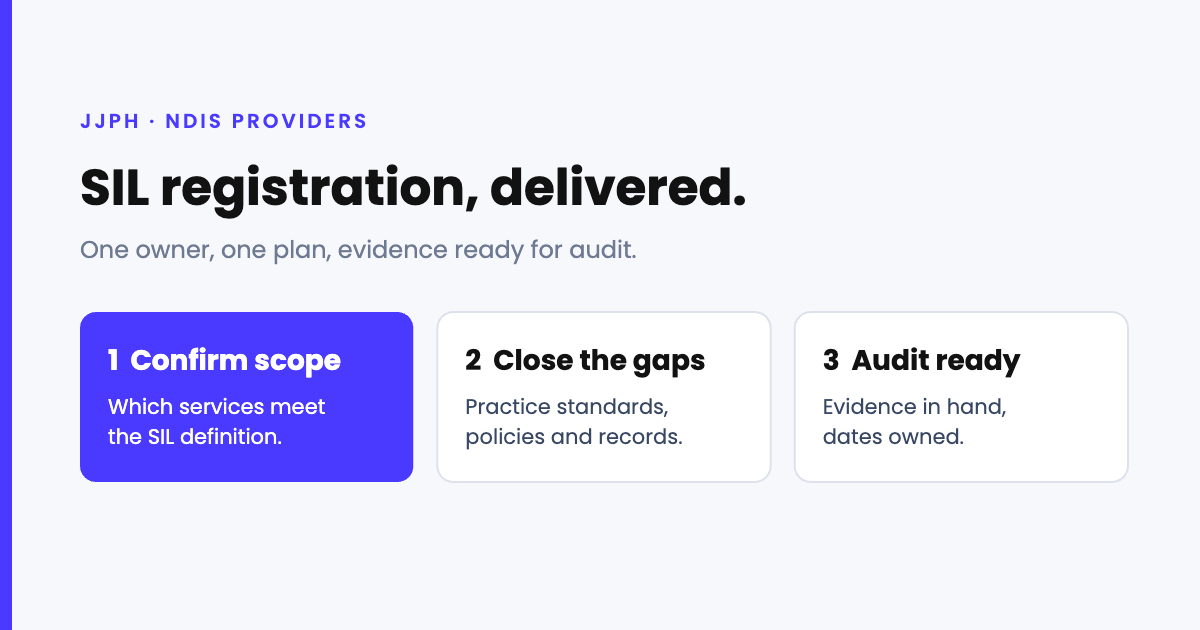
Supported independent living (SIL) providers have needed NDIS registration since 1 July 2026. Registration brings certification audits and a new set of practice standards. Getting ready is a delivery job: one owner, one plan, evidence you can show an auditor and a date for each step. Here is how we would run it with you.
What changed
From 1 July 2026, some SIL providers must register with the NDIS Quality and Safeguards Commission. The Commission added a new registration group, 0138, for assistance with supported independent living.
Registered SIL providers need to meet three things. They need certification audits. They need to comply with the core module of the NDIS Practice Standards. They also need to comply with a new supplementary module written for SIL.
Who it applies to
The Commission describes SIL as a package of home and living support for people with higher support needs. The person needs support at all times of the day, or for most of the day. The provider manages and delivers the package so the participant can live in their home as independently as possible.
It does not apply where someone receives only a few hours of support a day or week. It also does not apply where a person chooses and manages their own support workers, including directing, planning and rostering them. Your pathway to registration depends on your current status, so check the Commission's transition pathways page for your own situation.
What a provider has to deliver
Registration is a body of work with a deadline attached. In plain terms, a provider needs to do the following:
- Confirm which of your services meet the SIL definition and which do not.
- Compare current practice with the core module and the SIL supplementary module, and list the gaps.
- Fix the gaps: policies, procedures, records, training and the way incidents and complaints are handled.
- Collect evidence that shows the fixes are working day to day.
- Book and prepare for the certification audit.
Why this lands as a delivery problem
Most providers know their participants and their houses well. The strain comes from running registration alongside daily operations. Rosters, supports and incidents do not pause while a gap assessment gets done.
Work like this also crosses teams. Operations, quality, people and finance all hold part of the evidence. Without one person pulling it together, actions drift and the audit date gets closer.
How we would run it
We would embed a project manager into your team to own the registration plan. In the first weeks, we would set the baseline: which services are in scope, where the gaps sit and who owns each fix. From there, we would run a short weekly rhythm so your executive team sees progress, risks and decisions on one page.
The same person keeps the evidence organised as it is produced, so audit preparation builds as you go and does not become a rush at the end. When the audit is done, your team keeps the plan, the records and the routines. For more on how an embedded project manager works, see How We Work, and for the wider office behind them, see our Outsourced PMO.
Questions to ask before you start
- Which of our services meet the SIL definition?
- Who owns the registration plan day to day?
- Where are the biggest gaps against the supplementary module?
- What evidence do we already hold, and what do we still need to create?
- When is our audit, and what has to be done before it?
Common questions
What counts as supported independent living?
The Commission's definition covers a package of home and living support where the person needs support at all times or most of the day, and the provider manages and delivers it. Read the Commission's definition on its mandatory registration page before you decide where your services sit.
Where do I find my registration pathway?
The Commission publishes transition pathways based on whether you are registered, whether you are unregistered and whether you applied before 1 July 2026. Start there, then build your plan around the pathway that fits you.
Where to go next
If your team is carrying registration on top of daily operations, we are happy to talk it through. Our earlier article on NDIS project management that actually delivers shows how we approach delivery in the sector.
Source: NDIS Quality and Safeguards Commission, Mandatory registration and transition pathways for supported independent living (SIL), ndiscommission.gov.au.